
SQL vs NoSQL: What's the Difference? A Complete Guide
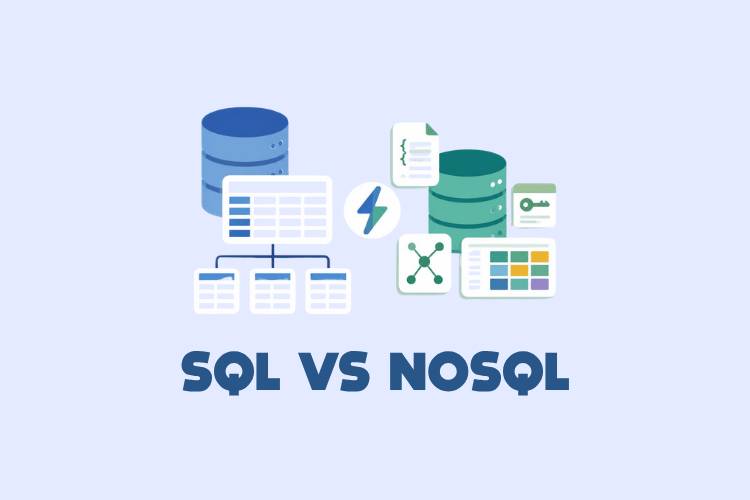
A database choice is one of the few architectural decisions that is genuinely expensive to undo. The SQL vs NoSQL debate sits at the center of it, and it is usually framed as a tribal war between legacy relational databases and modern alternatives. The reality is more interesting: they are different tools built for different problems, and the right answer depends on your data shape, access patterns, consistency needs, and team. This guide breaks down how SQL and NoSQL databases actually differ in data modeling, querying, scaling, consistency, performance, and security, and gives you a practical framework for choosing one without regret.
Key Takeaways
- SQL databases store normalized data in tables with a fixed schema and enforce ACID transactions. NoSQL databases store documents, key-value pairs, wide-column rows, or graph nodes with flexible schemas.
- The real trade-off is not relational versus non-relational. It is strong consistency versus availability, joins versus denormalization, and vertical versus horizontal scaling.
- NoSQL shines for high-volume, semi-structured workloads: event logs, product catalogs, user sessions, real-time feeds, and recommendation graphs.
- SQL remains the safer default for anything with complex relationships, multi-row transactions, or strict integrity rules, such as billing, inventory, payroll, and financial reporting.
- Most production systems are polyglot: a SQL database for the transactional core plus NoSQL stores for caching, search, and analytics.
What Is SQL? A Primer on Relational Databases
SQL stands for Structured Query Language. It is the standard language for talking to a relational database management system (RDBMS), a database that organizes data into tables of rows and columns and expresses relationships between those tables with keys.
Popular SQL databases include PostgreSQL, MySQL, MariaDB, Microsoft SQL Server, Oracle Database, and SQLite. They differ in licensing, extensions, and operational tooling, but they share the same fundamental model.
The Core Principles Behind SQL Databases
- Tables, rows, and columns. A table represents one entity type, such as customers. Each row is one instance, and each column holds one attribute with a declared type.
- A fixed schema. Columns and types are defined before data is written. Changing the schema requires a migration such as ALTER TABLE.
- Primary keys. Every row is uniquely identified, which makes updates and deletes predictable.
- Foreign keys and relationships. Constraints guarantee that a row cannot reference a parent row that does not exist.
- Declarative queries. You describe the result you want, and the query planner decides how to fetch it using indexes, joins, and statistics.
A Small SQL Schema Example
The following DDL creates two related tables with a foreign key and a check constraint. Declarative constraints are one of the biggest practical advantages of relational databases.
CREATE TABLE customers (
    id         BIGINT PRIMARY KEY,
    email      TEXT NOT NULL UNIQUE,
    created_at TIMESTAMP NOT NULL DEFAULT NOW()
);

CREATE TABLE orders (
    id          BIGINT PRIMARY KEY,
    customer_id BIGINT NOT NULL REFERENCES customers(id),
    total_cents INTEGER NOT NULL CHECK (total_cents >= 0),
    placed_at   TIMESTAMP NOT NULL DEFAULT NOW()
);
The database itself now rejects negative totals and rejects orders that point at a customer that does not exist. No application code has to remember those rules, and no future bug can silently violate them.
ACID Transactions in SQL
Relational databases are built around ACID guarantees. Atomicity means a transaction either fully commits or fully rolls back. Consistency means constraints hold before and after. Isolation means concurrent transactions do not see each other's partial work. Durability means committed data survives a crash.
Transferring money between two accounts is the classic example, and it only works if both statements succeed or neither does.
BEGIN;

UPDATE accounts SET balance_cents = balance_cents - 10000 WHERE id = 1;
UPDATE accounts SET balance_cents = balance_cents + 10000 WHERE id = 2;

COMMIT;
If the process crashes between the two updates, the database rolls the whole transaction back. You get exactly the same guarantee across ten tables, not just two, which is why financial systems still gravitate toward relational storage.
What Is NoSQL? Understanding Non-Relational Databases
NoSQL means Not Only SQL. The term covers a wide family of databases that abandon the strict table-and-row model in exchange for flexible schemas, simpler scaling paths, and data models that match how applications actually read and write.
NoSQL grew out of a practical problem: web-scale workloads with hundreds of millions of users produced write volumes and data shapes that single-node relational databases struggled to handle cost-effectively. The goal was never to replace SQL everywhere, it was to offer a different set of trade-offs.
The Four Main Families of NoSQL Databases
- Document databases such as MongoDB, Couchbase, and Amazon DocumentDB store self-describing JSON-like documents. Related data is embedded in the same document instead of split across tables.
- Key-value stores such as Redis, DynamoDB, and Memcached map a key to an opaque value. They are extremely fast because lookups never require parsing, filtering, or joining.
- Wide-column stores such as Apache Cassandra, ScyllaDB, and HBase organize data into partitions and clustering columns designed for massive write throughput.
- Graph databases such as Neo4j, Amazon Neptune, and JanusGraph store nodes and edges, making traversal queries like friend-of-a-friend fast and readable.
A Small Document Database Example
Here is an order stored as a single document. Everything the application needs to render an order summary is available in one read.
db.orders.insertOne({
  _id: 'ord_1042',
  customerId: 'cus_88',
  status: 'shipped',
  lines: [
    { sku: 'KB-01', qty: 1, priceCents: 8999 },
    { sku: 'MS-14', qty: 2, priceCents: 2499 }
  ],
  placedAt: new Date('2025-03-04T10:15:00Z')
});
Fetching that order later is a single primary-key lookup with no joins, which is exactly why document stores handle read-heavy catalog and profile workloads so well.
A Small Key-Value Example
Redis stores a session with an expiration in one round trip. The value is opaque to the database, which keeps the operation extremely fast.
SET session:9f2c user:88 EX 3600
GET session:9f2c
The key expires automatically after one hour. That is a database feature doing work that would otherwise require a scheduled cleanup job in SQL.
A Small Graph Example
Graph databases express relationships as first-class citizens. This Cypher query finds everyone a user follows.
MATCH (u:User {id: 'u1'})-[:FOLLOWS]->(f:User)
RETURN f.name
LIMIT 10;
In SQL the same query needs a join table, and each additional hop adds another join. In a graph database, traversal depth costs roughly the same regardless of how many nodes exist in the graph.
A Small Wide-Column Example
Cassandra tables are designed around the query you want to run. The partition key decides which node owns the data.
CREATE TABLE events_by_day (
    day        date,
    event_time timestamp,
    device_id  text,
    payload    text,
    PRIMARY KEY ((day), event_time, device_id)
);
Because the partition key is the day, all events for one day live on the same node and can be read in order without a global sort. That design is what allows wide-column stores to absorb millions of writes per second.
SQL vs NoSQL: The Core Differences Compared
Strip away the marketing and the differences reduce to a handful of concrete dimensions. The list below is the fastest way to reason about SQL versus NoSQL for a new project.
- Data model: tables, rows, and columns in SQL versus documents, key-value pairs, wide rows, or graphs in NoSQL.
- Schema: enforced and migrated in SQL versus flexible and application-managed in NoSQL.
- Relationships: handled with foreign keys and joins in SQL versus embedding, referencing, or graph edges in NoSQL.
- Transactions: multi-row and multi-table ACID transactions in SQL versus single-document or limited-scope transactions in most NoSQL systems.
- Consistency: strong by default in SQL versus tunable, often eventual, consistency in many NoSQL systems.
- Scaling: vertical scaling with read replicas in SQL versus built-in horizontal partitioning in NoSQL.
- Query language: the standardized SQL dialect versus per-database APIs such as MQL, CQL, Cypher, or PartiQL.
- Maturity: decades of tooling, reporting, and operational knowledge in SQL versus faster-moving but younger ecosystems in NoSQL.
Notice that none of these dimensions is inherently better. They are choices, and each one shifts cost from one part of your system to another.
Data Modeling: Tables and Joins vs Documents and Embedding
Data modeling is where the SQL versus NoSQL decision becomes real. Relational modeling normalizes data to remove duplication. NoSQL modeling denormalizes data to remove joins.
In a normalized SQL schema, an order lives in one table and its line items in another. Reading a full order means joining three tables.
SELECT o.id, c.email, l.sku, l.qty
FROM orders o
JOIN customers c ON c.id = o.customer_id
JOIN order_lines l ON l.order_id = o.id
WHERE o.id = 1042;
The join reads three tables and returns a combined result set. In exchange, updating a customer email changes exactly one row, and nothing can drift out of sync.
The document equivalent stores the same order as one nested object, and the read becomes a single lookup.
db.orders.findOne({ _id: 'ord_1042' });Reads are dramatically simpler and faster, but the trade-off moves to writes. If the customer changes their email, you either update every order that embedded it or store a reference and pay for a second lookup in application code.
How to Choose Between Embedding and Referencing
- Embed when the child data is always read with the parent, rarely changes, and is bounded in size.
- Reference when the child data is large, shared between many parents, or updated independently of the parent.
- Duplicate deliberately when you need read speed and can tolerate a background job that reconciles the copies.
There is no universally correct answer. The correct answer is the one that matches your read and write ratio.
Schema Flexibility: Rigid vs Dynamic in SQL and NoSQL
A relational schema is a contract enforced by the database. A NoSQL schema is a convention enforced by the application, sometimes with optional validation rules. Each approach fails in a different way.
Rigid schemas fail loudly at write time. A missing column or a wrong type throws an error immediately, which is exactly what you want in a system where bad data is expensive.
Dynamic schemas fail quietly at read time. A document without the expected field simply returns null, and the bug surfaces three screens later in production. That is the price of flexibility, and it is why application-level validation matters more in NoSQL.
Adding Flexibility to a SQL Database
You do not have to give up SQL to get flexible fields. PostgreSQL, MySQL, and SQL Server all support JSON columns for the small number of attributes that genuinely vary.
CREATE TABLE products (
    id    BIGINT PRIMARY KEY,
    name  TEXT NOT NULL,
    attrs JSONB NOT NULL DEFAULT '{}'::jsonb
);
Attributes that vary by category, such as color, memory, or sleeve length, live in the JSON column while the stable columns stay typed and indexed.
SELECT name
FROM products
WHERE attrs->>'color' = 'red';
This hybrid approach is one of the most underused patterns in modern application design. You get relational integrity for the core and schema-on-read for the edges.
Adding Structure to a NoSQL Database
MongoDB supports JSON Schema validation, so you can enforce required fields and allowed values at the database level without giving up the document model.
db.createCollection('orders', {
  validator: {
    $jsonSchema: {
      bsonType: 'object',
      required: ['customerId', 'status'],
      properties: {
        customerId: { bsonType: 'string' },
        status: { enum: ['pending', 'shipped', 'cancelled'] }
      }
    }
  }
});
Documents that violate the schema are rejected on insert. The flexibility is still there, you simply choose which parts of it to constrain and which parts to leave open.
Consistency Models: ACID vs BASE and the CAP Theorem
Consistency is the most misunderstood dimension of the SQL vs NoSQL comparison. It is not about whether data is safe, it is about when reads are guaranteed to reflect the latest write.
ACID Versus BASE
SQL databases traditionally provide ACID semantics. Many NoSQL databases follow BASE: Basically Available, Soft state, Eventual consistency. Under eventual consistency, a read may return stale data for a short window, but the system keeps accepting writes and stays available during network partitions.
That window is usually milliseconds, but it is visible. A user might post a comment and not see it on a different replica for a moment, or complete a transfer and see an old balance on the next screen.
What the CAP Theorem Actually Says
The CAP theorem states that a distributed system can guarantee only two of three properties during a network partition: consistency, availability, and partition tolerance. Because partitions happen in any real network, partition tolerance is mandatory, and the practical choice is between consistency and availability.
- CP systems refuse writes rather than serve stale data. Most relational clusters and systems like HBase behave this way.
- AP systems keep serving reads and writes and reconcile later. Cassandra and DynamoDB are typical examples.
- PACELC extends the idea: even without a partition, you still trade latency against consistency on every request.
Tunable Consistency in NoSQL
Many NoSQL databases let you dial consistency per query. Cassandra accepts a consistency level describing how many replicas must respond before the operation succeeds.
CONSISTENCY QUORUM;
SELECT * FROM users WHERE id = 'u1';
Quorum requires a majority of replicas, which gives strong consistency at the cost of extra latency. Setting consistency to ONE returns faster but may serve a stale value. That per-query control is something traditional SQL databases rarely expose.
Scaling SQL vs NoSQL: Vertical, Horizontal, and Sharding
Scaling is the argument people cite most often in the SQL vs NoSQL debate, and it is also the most oversimplified. Both models scale. They just scale differently.
Vertical Scaling and Read Replicas in SQL
The cheapest way to scale a relational database is to give it more CPU, memory, and faster storage. A single modern server can handle tens of thousands of simple transactions per second, which is far beyond what most applications need.
When reads dominate, add read replicas and route reporting or search traffic to them. When writes dominate, the usual next steps are partitioning large tables, tuning indexes, and batching work before considering anything exotic.
Horizontal Scaling and Sharding in NoSQL
NoSQL databases were designed from the start to spread data across many commodity nodes. Adding a node increases both storage and throughput, and the database rebalances automatically.
Sharding means choosing a partition key and spreading data across shards based on it. The choice is permanent in practice, because repartitioning a live system is expensive and risky. A poor key creates a hot partition that receives most of the traffic while other nodes sit idle.
Why Writes Are Harder to Scale Than Reads
Reads can be duplicated. Writes cannot. Every replica has to apply the same write, and every distributed write has to coordinate with peers. That coordination is why strongly consistent clusters are harder to scale horizontally than eventually consistent stores, and why write-heavy workloads often push teams toward NoSQL.
Query Languages and Developer Experience
SQL has a huge practical advantage: it is a standard. Skills, tools, ORMs, and reporting software transfer between PostgreSQL, MySQL, and SQL Server with minor differences that developers learn in days.
NoSQL query languages are database-specific. MongoDB uses an aggregation pipeline, Cassandra uses CQL, Neo4j uses Cypher, and DynamoDB uses PartiQL or a document client. Each is expressive in its own domain, but none is universal.
Example: Filtering and Aggregating in SQL
SELECT status, COUNT(*) AS orders, SUM(total_cents) AS revenue_cents
FROM orders
WHERE placed_at >= DATE '2025-01-01'
GROUP BY status
ORDER BY revenue_cents DESC;
Analysts can read this query without knowing anything about the application. That readability is a real organizational asset when business users need answers quickly.
Example: The Same Aggregation in MongoDB
db.orders.aggregate([
  { $match: { placedAt: { $gte: new Date('2025-01-01') } } },
  { $group: {
      _id: '$status',
      orders: { $sum: 1 },
      revenueCents: { $sum: '$totalCents' }
  } },
  { $sort: { revenueCents: -1 } }
]);
The pipeline is clear and powerful, but it is code rather than a declarative standard, and it embeds the shape of your documents into the query itself.
ORMs, ODMs, and Drivers
Object-relational mappers abstract away SQL for simple CRUD operations and help with migrations and type safety. They become awkward for complex reporting queries, where hand-written SQL usually wins. Document databases have their own ODMs, such as Mongoose for Node.js, which add schema validation and middleware hooks.
Performance Considerations in SQL vs NoSQL
Performance in both worlds comes down to one idea: make the database do less work per request. Indexes, query shape, and data locality matter far more than the label on the database.
Indexing
A composite index lets the database satisfy a query without scanning the table.
CREATE INDEX idx_orders_customer_placed
ON orders (customer_id, placed_at DESC);
The document equivalent uses a compound index on the same fields, so the sort order matches the query.
db.orders.createIndex({ customerId: 1, placedAt: -1 });In both cases the rule is the same: index the fields you filter and sort on, in the order the query uses them, and verify with the query planner or explain output rather than guessing.
Denormalization and Amplification Costs
Relational databases pay read amplification: one logical object may require several table reads. NoSQL databases pay write amplification: one logical update may require rewriting a large document or updating several denormalized copies. Neither is free, and the right choice depends on whether your workload is read-heavy or write-heavy.
The N+1 Query Problem
The N+1 problem appears in both models when application code loops over parents and fetches children one at a time. In SQL the fix is a join or a batched IN query. In document stores the fix is an aggregation with a lookup stage or a single query returning all child documents by a shared key.
Connection Pooling and Latency
Relational databases depend heavily on connection pooling because each connection carries real memory cost. NoSQL clients typically manage pools internally and tolerate higher connection counts, which simplifies deployment in serverless environments where instances scale up and down quickly.
Caching Beats Most Database Changes
Almost every high-traffic system puts a cache in front of the database. Redis or Memcached absorbs repeated reads, and the database handles the rest. Caching is orthogonal to the SQL versus NoSQL choice and often delivers more improvement than switching databases ever would.
Security Considerations for SQL and NoSQL Databases
Security is a place where the two models differ in specifics but not in principles: validate input, use least privilege, encrypt data, and log access.
SQL Injection
SQL injection happens when user input is concatenated into a query string. The classic vulnerable pattern looks like this.
query = 'SELECT * FROM users WHERE email = ' + email
db.execute(query)
A crafted email value can terminate the string and append arbitrary SQL. Parameterized queries fix this because the value is transmitted separately and never parsed as SQL.
const rows = await pool.query(
  'SELECT id, email FROM users WHERE email = $1',
  [email]
);
The same approach applies in every language: bound parameters, prepared statements, or a query builder that escapes correctly. Never build query strings by hand.
NoSQL Injection
NoSQL injection is less well known but equally dangerous. Consider a login handler that passes request data straight into a query.
db.users.find({ email: email, password: password });If an attacker sends an object instead of a string, for example a value using the $ne or $gt operators, the query can match a record without knowing the correct password. The fixes are strict type checking, schema validation, and never passing raw request bodies into query objects.
Access Control, Encryption, and Auditing
- Least privilege. Application users should only have the permissions they need. A web service rarely needs DDL rights or access to every schema.
- Encryption in transit and at rest. Require TLS for client connections and enable storage encryption. Both are standard in managed services and often one configuration flag away in self-hosted setups.
- Network isolation. Keep databases in private subnets and never expose their ports directly to the internet.
- Auditing. Log authentication events and administrative changes. Most breaches are discovered months after the fact, and logs are the only reliable timeline.
- Regular patching. Both ecosystems ship security fixes that matter, and running an unpatched version is a choice you make every day.
Real-World Use Cases: When SQL Wins and When NoSQL Wins
Abstract comparisons only go so far. These concrete scenarios show where each model has a clear advantage.
Where SQL Databases Shine
- Financial systems. Ledgers, payments, and billing need multi-row transactions and auditability.
- Inventory and order management. Stock levels must be exactly correct, and relationships between products, warehouses, and orders are naturally relational.
- Reporting and analytics. Ad-hoc queries and BI tools assume SQL, and the language is well suited to aggregation over structured data.
- Systems with evolving but stable entities. If the shape of your data is well understood, a schema is documentation that stays honest.
- Regulated environments. Data lineage, constraints, and mature access control make compliance easier.
Where NoSQL Databases Shine
- Content and product catalogs. Documents let each product carry its own attributes without a wide, mostly empty table.
- High-volume event and telemetry data. Wide-column stores ingest millions of writes per second from devices and applications.
- Sessions, caches, and rate limiters. Key-value stores answer in sub-millisecond time with native key expiration.
- Social and recommendation graphs. Relationship traversal is a natural fit for graph databases.
- Rapidly evolving prototypes. Skipping migrations early can shorten iteration cycles, though the debt tends to arrive later.
Hybrid Architectures in Practice
A typical e-commerce platform might use PostgreSQL for orders and payments, Redis for sessions and carts, Elasticsearch for search, and a document store for the product catalog. Each database handles what it is best at, and the application orchestrates between them.
Polyglot Persistence: Using SQL and NoSQL Together
Polyglot persistence means deliberately using multiple database technologies in one system. It is the norm rather than the exception in large applications, and it neutralizes most of the SQL vs NoSQL argument by letting you choose per workload.
- Transactional core. A relational database owns money, entitlements, and anything that must never be inconsistent.
- Caching layer. A key-value store absorbs repeated reads and holds ephemeral state like sessions and verification codes.
- Search index. A search engine or document store handles full-text queries, faceting, and relevance ranking that would strain a relational planner.
- Analytics store. A columnar warehouse or wide-column store holds append-only history for reporting without competing with transactional traffic.
- Object storage. Large binaries live in blob storage, with the database holding only metadata and pointers.
The cost of polyglot persistence is operational complexity. Every additional database adds backups, monitoring, upgrades, and failure modes. Add one only when it solves a problem the current stack genuinely cannot.
Avoid Distributed Transactions Across Stores
Once you run more than one database, keep writes inside a single store per business operation. Use an outbox table or a change data capture stream to propagate changes to derived stores instead of writing to both at once. This keeps failures recoverable and avoids two-phase commit across systems that were never designed to cooperate.
Common Mistakes When Choosing Between SQL and NoSQL
- Choosing NoSQL purely for scale you do not have. Most applications never outgrow a single well-indexed PostgreSQL instance.
- Assuming NoSQL means schemaless. The schema still exists, it just lives in your application code where the compiler cannot check it.
- Modeling documents like tables. Copying a normalized schema into one collection per table loses all the benefits and keeps all the costs.
- Picking a database for one query. Optimize for the whole access pattern, not a single report.
- Ignoring consistency requirements. Eventual consistency is a product decision as much as a technical one.
- Underestimating operations. A database you cannot back up, restore, and monitor confidently is a liability regardless of its benchmark numbers.
- Treating the choice as permanent. Teams migrate in both directions all the time, usually by running both systems side by side during a cutover.
Best Practices for SQL and NoSQL Databases
- Start from access patterns. Write down the five most frequent queries before you pick a model, and design the schema to serve them.
- Model around reads, then verify writes. NoSQL favors read performance, so confirm that your write volume can absorb the denormalization.
- Index deliberately. Every index speeds reads and slows writes. Review unused indexes and remove them.
- Use migrations or validation. Even flexible schemas need a controlled path for structural change.
- Wrap multi-step writes in transactions whenever the database supports them, and design idempotent operations when it does not.
- Benchmark with realistic data. A schema that performs well on ten thousand rows may collapse at ten million.
- Automate backups and test restores. An untested backup is a guess, not a plan.
- Monitor the right metrics. Track query latency percentiles, slow query logs, replication lag, and connection pool saturation.
- Keep a single source of truth. Derived stores like search indexes should always be rebuildable from the primary database.
Migrating Between SQL and NoSQL
Migrations are more common than the SQL vs NoSQL debate suggests, and the safe pattern is the same in both directions.
- Map the model. Decide which tables become collections or partition keys, and which relationships become references.
- Run both systems in parallel. Dual-write to the old and new stores, or use change data capture to stream updates.
- Backfill historical data with a resumable job, verifying row counts and checksums as you go.
- Shadow read. Serve production traffic from the old database while comparing results from the new one to catch discrepancies.
- Cut over gradually by feature or by percentage of traffic, keeping a rollback path available at every step.
- Decommission only after a full business cycle confirms that nothing still depends on the old system.
Two warning signs deserve attention before you commit: if your target model requires joins the new database cannot perform, or if it depends on multi-document transactions at high volume, the migration will be painful and possibly the wrong move.
Frequently Asked Questions About SQL vs NoSQL
Is NoSQL faster than SQL?
Not inherently. NoSQL databases are often faster for specific patterns such as single-key lookups or high-volume appends, because they avoid joins and coordination. A well-indexed relational query can be just as fast, and for complex aggregations SQL is frequently faster because the query planner is more mature.
Can a NoSQL database handle transactions?
Yes, within limits. MongoDB supports multi-document transactions across replicas and shards, and DynamoDB offers transactional writes for small item sets. These transactions typically cost more and scale less gracefully than the same operation in a relational database, so use them sparingly.
Does NoSQL mean I do not need a schema?
No. It means the schema is not enforced by the database unless you enable validation. You still need a defined shape for your documents, and you should enforce it in application code, a validation layer, or with JSON Schema rules.
Which is better for a startup building an MVP?
A relational database is usually the safer start, because the data model is likely to change and migrations are more reliable than ad-hoc application changes. Managed PostgreSQL providers make setup trivial and scale further than most early products ever need.
When should I choose a document database over SQL?
Choose a document database when your entities are self-contained, read as a whole, and have variable attributes, or when your throughput requirements exceed what a single relational instance can serve and you cannot partition the schema easily.
Can I use SQL and NoSQL in the same application?
Absolutely, and most large systems do. Use relational storage for the transactional core, a key-value store for caching and sessions, and a search or document store for flexible queries. The challenge is operational, not architectural.
How do I handle joins in NoSQL?
You either embed the related data, store references and fetch them in the application with a batched query, or use the database's own lookup capability such as a MongoDB aggregation lookup stage. Each approach trades storage or write cost for read speed.
Is SQL a good choice for big data?
SQL is excellent for structured analytics at scale, and many modern analytical engines accept SQL dialects over distributed storage. The limiting factor is usually the transactional engine, not the language itself.
What are NewSQL databases?
NewSQL systems such as CockroachDB, TiDB, and Google Spanner aim to combine SQL semantics with horizontal scalability and distributed consensus. They are a strong option when you need ACID guarantees and global scale, though they add latency and operational complexity compared with a single-node database.
Which database should I learn first?
Learn SQL first. The concepts of normalization, indexing, transactions, and query planning transfer everywhere, and most NoSQL systems assume you already understand those ideas. After that, pick one document store and one key-value store and build something small with each.
How do I test which one performs better for my workload?
Build a small benchmark with realistic data volumes and access patterns, then measure p95 and p99 latency, throughput, and cost. Synthetic benchmarks at unrealistic scales produce misleading answers, and so does testing only the happy path.
Making the Right Call Between SQL and NoSQL
The SQL versus NoSQL question has a boring but honest answer: pick the database that matches your data model, your consistency requirements, and your team's operational ability, and change it later if you are wrong. Both categories are mature, both scale, and both have production war stories.
Default to a relational database when your data has clear relationships, when correctness matters more than raw write throughput, and when you need ad-hoc reporting. Default to NoSQL when your entities are self-contained, your writes are enormous and append-heavy, or your access patterns are strictly key-based.
Three next steps will get you to a decision faster than any amount of further reading:
- Write down your five most important queries with their expected frequency and data volume.
- Model the data twice, once normalized and once as documents or partition keys, then see which one your queries fit better.
- Prototype on both with realistic data, and measure latency, cost, and the amount of application code each option requires.
Finally, resist designing for a scale you have not reached. The database that is easiest to operate today will let your team ship faster, and the day you genuinely outgrow it, you will have both the traffic and the engineering capacity to migrate.